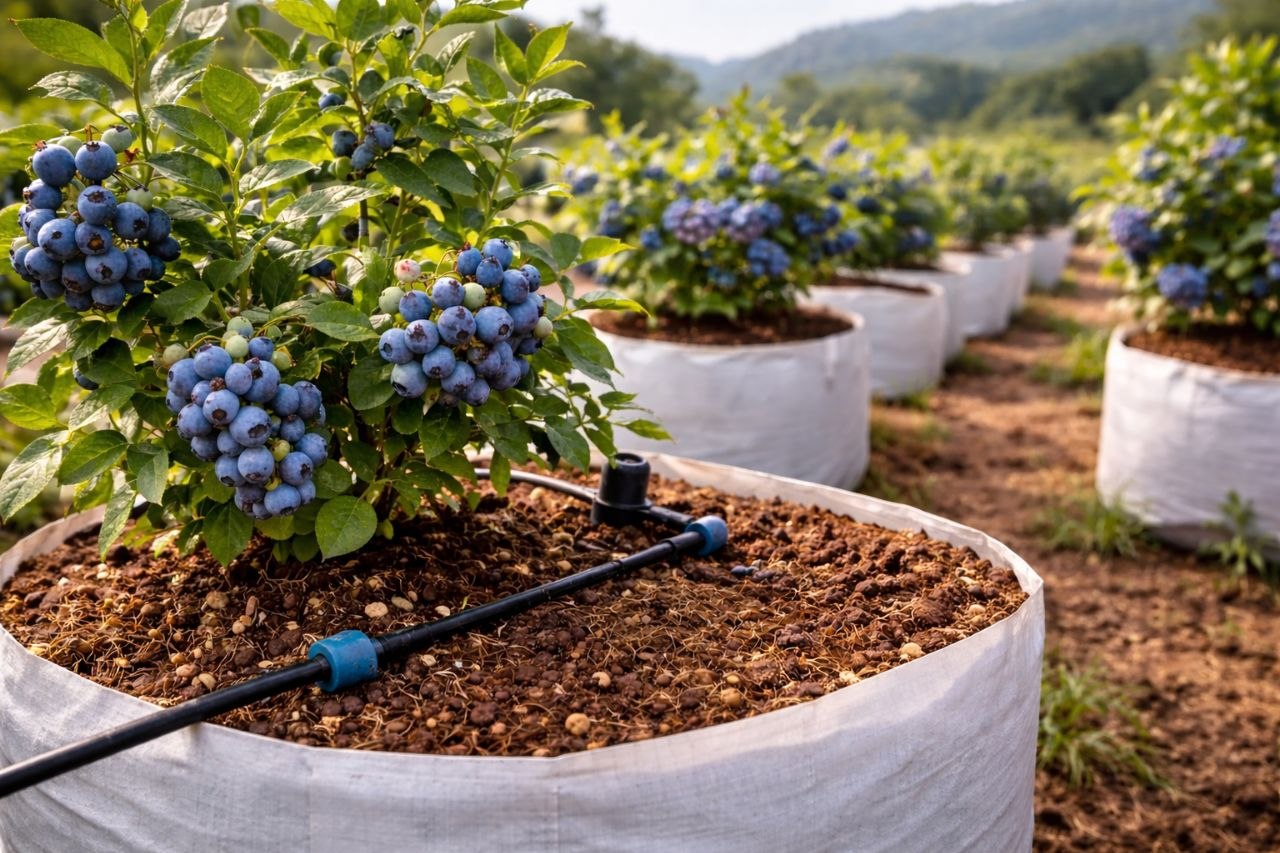
What is Blueberry ,Blueberry is a small, round, sweet-tasting berry with a deep blue colour and a natural powdery coating. It grows on a perennial bush plant that can live 8-10 years or more with good care. Originally from cooler regions, blueberry plants are now successfully grown in India using modern techniques
The plant is a woody shrub that reaches 1-2 metres height. It produces clusters of white flowers in spring followed by green berries that turn blue when ripe. Unlike many Indian fruits, blueberries need acidic soil and consistent moisture. For Indian farmers and beginners, it is an exciting crop because one healthy plant can yield 2-5 kg of fruit per year once mature. Blueberry farming in India is still new but growing fast due to high demand in supermarkets, hotels, and online platforms.
What is Blueberry ,Why It is Important
Blueberry farming in India brings many advantages for farmers, income, and plant growth:
- High income potential: Mature plants can give ₹20-30 lakh net profit per acre every year after the third year.
- Strong market demand: Cities love fresh blueberries; India imports thousands of tonnes every year, so local produce sells quickly at good prices.
- Long-term returns: One-time planting gives fruit for 8-10 years with low recurring costs.
- Better plant growth: Bushes are hardy, need less spraying than many crops, and improve soil health when grown with organic methods.
- Business angle: You can sell fresh berries, start a small nursery, or supply to exporters for extra profit.
- Organic farming India friendly: Works well with natural mulches and neem-based pest control.
Blueberry plant care India is simple once you understand the basics, making it perfect for small and medium farmers looking for profit farming opportunities
Step-by-Step Guide to Blueberry Farming in India
Here are 7 practical steps designed for Indian conditions. Follow them carefully for good results.
Step 1: Choose the Right Location and Climate
Pick a site with 6-8 hours of sunlight and good air flow. Blueberry plants grow best in cooler hills or regions with low-chill varieties. Suitable states include Himachal Pradesh (Kullu, Manali), Uttarakhand, Maharashtra, Karnataka, Tamil Nadu, and parts of Northeast India
Avoid water-logged or very hot plains without shade. Test your land for gentle slope to help drainage. Small farmers can start in grow bags or raised beds if open soil is not suitable. This step prevents 80% of future problems. Spend time visiting successful farms in your area before investing.
Step 2: Prepare Acidic Soil or Growing Media
Blueberries love acidic soil with pH 4.5-5.5. Most Indian soils are alkaline, so mix cocopeat (60%), pine sawdust or peat moss (20-30%), and a little vermicompost. Add elemental sulphur to lower pH. For 1-acre farm, use grow bags (50-litre size) or raised beds filled with this media
Test pH every month with a simple kit. Good drainage is must to avoid root rot. This preparation costs money upfront but saves plants later. Many farmers in Maharashtra and Himachal use this method successfully. (98 words)
Step 3: Select and Buy the Best Varieties
Choose low-chill or zero-chill varieties for Indian weather. Good options: Biloxi (zero chill, great for South India), Emerald and Misty (low chill, suitable for Maharashtra and Karnataka), Legacy (medium chill, best in Himachal). Buy 1-2 year old healthy tissue-culture plants from trusted nurseries. Plant at least two varieties together for better pollination. Start with 1,200-2,000 plants per acre depending on spacing. This step decides your total yield and profit.
Step 4: Plant the Blueberry Plants Correctly
Best planting time is February-March in North India and September-November in South. Dig holes or place in grow bags with proper spacing (1-1.2 metre between plants, 2-3 metre between rows). Plant at the same depth as the nursery pot. Water immediately after planting. Add mulch around the base to keep roots cool and moist. Avoid planting in peak summer heat. This careful planting gives 90% survival rate for beginners.
Step 5: Set Up Irrigation and Mulching
Blueberries need consistent moisture but hate waterlogging. Install drip irrigation system for daily watering (twice a week in normal weather, more in summer). Use mulch (pine bark or cocopeat) 4-5 cm thick to stop weeds and keep soil cool. Check soil moisture by putting finger 5 cm deep – it should feel moist but not wet. This system saves water and labour in Indian farms.
Step 6:Provide Fertilization, Pruning and Pest Care
Use acidic fertilizers (ammonium-based) through drip (fertigation). Prune lightly every year after harvest to remove weak branches and open the bush. Watch for birds – use netting. Control pests with neem oil or organic sprays. Keep pH and EC in check. This regular care keeps plants healthy and increases berry size.
Step 7: Harvest and Sell Your Produce
Berries turn fully blue and sweet in 45-60 days after flowering. Harvest by hand every 3-4 days. Pick when firm. Sort by size and pack in 125g or 250g boxes. Sell fresh to local markets, online, or hotels. Proper cold storage helps longer shelf life. Start small and build direct buyer contacts for best price.
Common Mistakes to Avoid
- gnoring soil pH – plants die fast if soil is not acidic.
- Planting wrong variety for your state – low yield or no fruit.
- Overwatering or poor drainage – causes root diseases.
- Skipping bird netting – birds can finish your entire crop.
- Not pruning – bushes become crowded and produce small berries.
- Buying cheap, unhealthy plants – low survival and poor profit.
- Selling without grading – lower price and unhappy buyers.
Beginners in blueberry farming India often lose money due to these easy-to-fix mistakes. Test everything small first.
Cost, Profit & Investment
Basic cost in INR (1 acre, Year 1): ₹5-8 lakh (using 1,200-1,500 plants at ₹500-800 each). This includes plants (₹5-6 lakh), soil media & bags (₹1-1.5 lakh), drip irrigation (₹50,000), and basic setup. Protected poly tunnels add extra ₹15-20 lakh but give higher yield.
Expected profit in India: Year 1-2: low or break-even (0.5-2 tonnes). Year 3+: 2.5-3.5 tonnes per acre. At wholesale ₹800-1,200 per kg, gross income ₹20-40 lakh. After costs, net profit ₹20-30 lakh per acre from Year 4 onwards. Many farmers report excellent returns with good management.
Market demand in India: Very high. Supermarkets, hotels, and online platforms pay premium for fresh local blueberries. India still imports a lot, so local supply sells fast. Profit farming with blueberries is one of the best options today
Best Varieties / Types in India
- Biloxi: Zero chill, perfect for Maharashtra, Karnataka, Tamil Nadu.
- Emerald & Misty: Low chill, good size, versatile in many states.
- Legacy: Medium chill, excellent for Himachal Pradesh (Kullu) and Uttarakhand.
- Sharp Blue: Beginner-friendly, royalty-free.
These varieties perform well in Indian conditions when matched to your local climate and chill hours. Start with 2-3 types together
Daily Care / Maintenance Routine
Morning: Check soil moisture and water if needed. Look at leaves for any yellowing. Afternoon: Inspect for pests or birds. Apply light mulch if dry. Monitor temperature (use shade net if above 35°C). Evening: Record pH and weather. Light hand weeding if required. This 15-20 minute routine keeps your blueberry plants healthy every day
Extra Tips for Better Yield
- Use organic farming India methods: neem oil for pests, vermicompost for nutrition.
- Install fertigation for precise feeding.
- Grow in poly tunnels for rain and heat protection.
- Mulch with pine needles to maintain acidity.
- Combine modern drip system with organic mulch for 20-30% higher yield.
- Start small (quarter acre) and scale after one successful season.
- Join farmer groups in your state for latest tips on blueberry plant care India.
These practical tips help you get maximum berries with less effort
FAQs
. What is Blueberry and is it profitable in India? Blueberry is a sweet blue berry grown on bushes. Yes, it is highly profitable after 3 years with net returns of ₹20-30 lakh per acre when managed well.
2. Which states in India are best for blueberry farming? Himachal Pradesh, Uttarakhand, Maharashtra, Karnataka, and Tamil Nadu are leading states. Low-chill varieties work in warmer areas.
3. How much does it cost to start blueberry farming on 1 acre? Around ₹5-8 lakh in the first year including plants, media, and irrigation. Subsidies are available under government schemes.
4. When do blueberry plants start giving fruit in India? Light crop from year 2, good commercial yield from year 3 onwards. Full production comes in year 4.
5. Can beginners grow blueberries in pots or grow bags? Yes, many small farmers in India use 50-litre grow bags with acidic media. It is easier to control pH.
6. What is the best time to plant blueberry plants in India? February-March in North India and September-November in South India for best survival.
7. How much water do blueberry plants need daily? Consistent moisture through drip – about 2-4 litres per plant daily depending on weather. Never let soil dry completely.
8. Do I need special permission or royalty for blueberry varieties? Royalty-free varieties like Biloxi and Sharp Blue are best for beginners. Check with nursery for patented types.
9. What is the current market price of blueberries in India? Wholesale price is ₹800-1,200 per kg. Retail is higher in cities.
10. How can I sell my blueberry produce? Sell to local mandis, online platforms, hotels, or exporters. Direct marketing gives better profit.
Conclusion
Blueberry farming in India is a real opportunity for smart farmers who want higher income. By understanding What is Blueberry, preparing acidic media, choosing right varieties, and following daily care, you can build a successful business. Start small, learn from experience, and watch your farm income grow. Many farmers in Himachal and Maharashtra are already earning lakhs every season. If you have land and willingness to learn, blueberry plants can become your best profit farming choice. Take the first step today – your high-return blueberry farm is waiting!